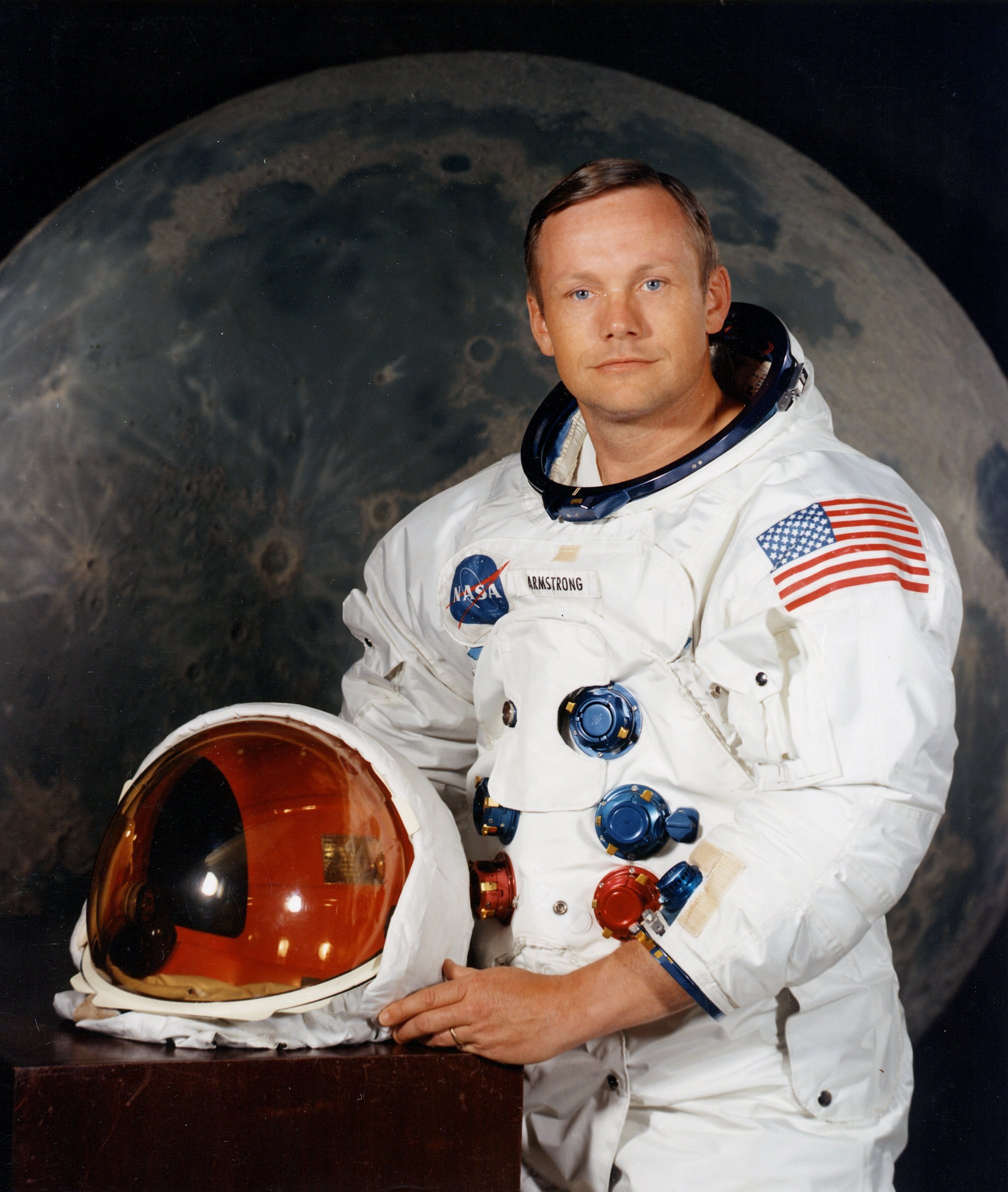
Two days ahead of President Obama's space policy summit at NASA's Kennedy Space Center, Apollo 11 commander Neil Armstrong released
an open letter condemning the administration's plan to scrap the back-to-the-moon Constellation program:
When President Obama recently released his budget for Nasa, he proposed a slight increase in total funding, substantial research and technology development, an extension of the International Space Station operation until 2020, long range planning for a new but undefined heavy lift rocket and significant funding for the development of commercial access to low earth orbit
Although some of these proposals have merit, the accompanying decision to cancel the Constellation program, its Ares 1 and Ares V rockets, and the Orion spacecraft, is devastating.
America’s only path to low Earth orbit and the International Space Station will now be subject to an agreement with Russia to purchase space on their Soyuz – at a price of over 50 million dollars per seat with significant increases expected in the near future – until we have the capacity to provide transportation for ourselves.
The availability of a commercial transport to orbit as envisioned in the President’s proposal cannot be predicted with any certainty, but is likely to take substantially longer and be more expensive than we would hope.
It appears that we will have wasted our current $10-plus billion investment in Constellation and, equally importantly, we will have lost the many years required to recreate the equivalent of what we will have discarded.
For The United States, the leading space faring nation for nearly half a century, to be without carriage to low Earth orbit and with no human exploration capability to go beyond Earth orbit for an indeterminate time into the future, destines our nation to become one of second or even third rate stature.
Under the President's space plan, resources will be shifted to private-sector rockets and a scaled-down version of Constellation's Orion crew capsule for emergency use to reduce NASA's reliance on the Russians for transport to and from the International Space Station (ISS).
Accordng to CBS News, the President's long range plans will focus on the development of a heavy-lift rocket for eventual manned space flight to a variety of deep space targets, including, ultimately, Mars.
NASA icon Chris Kraft, who directed mission control from Mercury through Apollo
is not impressed:
"They're concentrating on the wrong thing," Kraft said Tuesday evening. "The problem is not safety on space station and escape; the problem is getting to and from the space station."
And Kraft said he sees no reason to speed up work on a new larger rocket, saying, "We need a heavy-lift vehicle like we need a hole in the head."
With the retirement of the space shuttle at the end of this year, the U.S. will be entirely dependent on Russia for transportation to and from the International Space Station (
which has cost the U.S. $96 billion). The Russians aren't stupid. They recently doubled the price for Soyuz spacecraft passage to and from the ISS to
$55.8 million per astronaut. I'm sure more price increases will follow.